Welcome
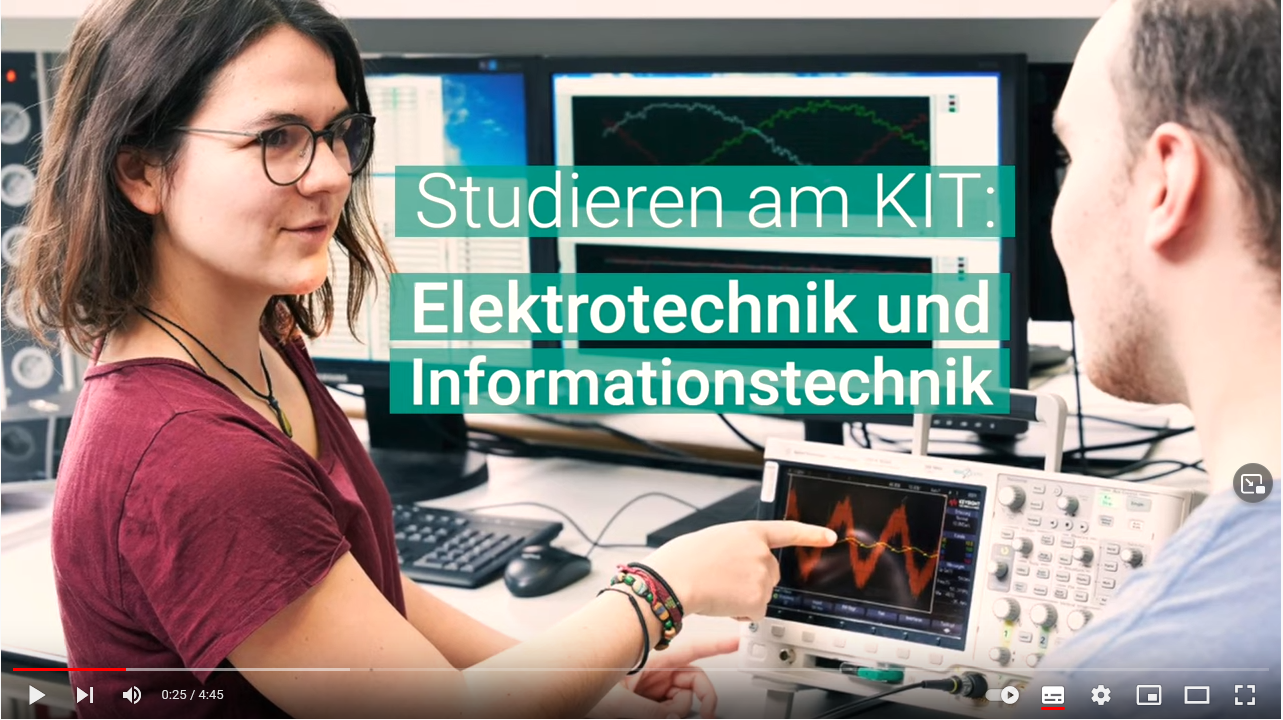
Climate change, medical progress, modern communication systems: For the challenges of the 21st century, we need experts in electrical engineering and information technology. For many years, the KIT department Electrical Engineering and Information Technology has held a top position in the German university landscape for the education of engineers in electrical engineering and information technology.
The Bachelor's program offers a broad basic education. The master's program builds on the knowledge acquired in the bachelor's program and deepens it in one of numerous specializations. This breadth of the bachelor's education in combination with the specialization in the master's program provides the best possible qualification for attractive and future-oriented professional fields:
Renewable energies, electromobility, information and communication technology, automation and systems engineering, micro- and nanoelectronics, photonics and quantum technology, medical technology.
The unique connection between university and the large-scale research center at KIT allows students insights into current large-scale research projects. In addition, the department offers attractive opportunities for doctoral studies for graduates interested in research following the master's program.
News

The new Energy Materials Acceleration Platform (E-MAP) at the Karlsruhe Institute of Technology (KIT) enables a systematic examination, evaluation, and targeted refining of thousands of material variants. It links automated experiments with precise material characterization, thus creating the foundation for the accelerated development of energy materials.
“Robot systems perform tasks such as preparing materials, handling samples, thin-film deposition and sample characterization,” said Dr. Holger Röhm from KIT’s Light Technology Institute (LTI), whose research team has set up the platform. “This allows us to conduct experiments with unprecedented precision and reproducibility. With the E-MAP, we can quickly identify which material compositions and production conditions are particularly promising for a specific application.” [...]

Tenure-Track Professor Johanna Schröder (IAM-ET) was awarded the prestigious Prize for Electrochemical Material Science – Energy of the International Society of Electrochemistry (ISE) for pioneering contributions to electrochemical materials science through innovative approaches linking catalyst structure and performance under realistic conditions.

The teams led by Professor Christian Koos, Dr. Philipp Dietrich, and Dr. Matthias Lauermann have been nominated for the German Future Award by the Federal President.
At the Institute of Photonics and Quantum Electronics (IPQ) and the Institute of Microstructure Technology (IMT) at KIT, the three nominees have found new ways to meet the growing demand for fast and efficient data exchange.
To achieve this, they are relying on light instead of electricity. Their new methods make it possible to efficiently test optical microchips and precisely integrate them into high-performance systems. These innovations have been brought to industrial application through the KIT spin-offs Vanguard Automation and Keystone Photonics. In this way, they contribute to faster, more scalable, and more energy-efficient data processing.
Link to the KIT press release

The EAC AI Alliance is supported by the East African Community in collaboration with international partners. Its goal is to advance the responsible use of AI through research, training, and innovative applications. The second edition of the AI4EAC Innovation Challenge was launched during the event. The program aims to reach 20,000 people in the member states of the East African Community and support young talent, researchers, and companies in developing AI-based solutions in the region. Representing KIT, Prof. Eric Sax from ITIV and his doctoral students Nikola Lukezic and Moritz Zink participated in the discussions.
Video of Prof. Eric Sax’s remarks at the press conference (starting at 01:44)

Partnership with the State Government and SUSS MicroTec creates jobs, a new professorship, and opportunities for students. SUSS MicroTec SE, one of the world’s leading manufacturers of equipment for the semiconductor industry, the state government of Baden-Württemberg, and the Karlsruhe Institute of Technology (KIT) plan to work together to advance the expansion of the chip industry in the state. In a Letter of Intent signed on Wednesday, July 29, 2026, the partners committed to cooperation and mutual support.

The PI Innovation Award is presented annually by Physik Instrumente (PI) and honors scientific work with exceptional potential for innovation and technology transfer. This year, Dr.-Ing. Fabian Sommer received the PI Innovation Award for his dissertation titled “Modeling, Design, and Operation of a High-Power Dual Active Bridge with a Focus on Parasitic Effects.” The award ceremony took place on the Day Of The Department of Electrical Engineering and Information Technology on July 31, 2026.
More about the award recipient and his dissertation