Welcome
Climate change, medical progress, modern communication systems: For the challenges of the 21st century, we need experts in electrical engineering and information technology. For many years, the KIT department Electrical Engineering and Information Technology has held a top position in the German university landscape for the education of engineers in electrical engineering and information technology.
The Bachelor's program offers a broad basic education. The master's program builds on the knowledge acquired in the bachelor's program and deepens it in one of numerous specializations. This breadth of the bachelor's education in combination with the specialization in the master's program provides the best possible qualification for attractive and future-oriented professional fields:
Renewable energies, electromobility, information and communication technology, automation and systems engineering, micro- and nanoelectronics, photonics and quantum technology, medical technology.
The unique connection between university and the large-scale research center at KIT allows students insights into current large-scale research projects. In addition, the department offers attractive opportunities for doctoral studies for graduates interested in research following the master's program.
News

As part of the IntelliSpine-Recon collaborative project, researchers are developing a virtual training environment for complex spinal tumor surgeries. Spinal tumor surgeries are complex and involve significant risks. To improve the planning of such procedures, the Karlsruhe Institute of Technology (KIT) is participating in the IntelliSpine-Recon research consortium. Coordinated by the University of Heidelberg, the project is developing a prototype for an assistance platform that uses a digital twin to support surgeons in preparing for spinal surgeries and is designed to reduce risks.

Researchers from KIT and its spin-off companies received the award in Berlin for groundbreaking developments in the Division of optical data transmission. On November 18, 2026, Federal President Frank-Walter Steinmeier presented the German Future Prize to Professor Christian Koos, Dr. Matthias Lauermann, and Dr. Philipp Dietrich. At KIT and in the spin-off companies Vanguard Automation and Keystone Photonics, the researchers developed a 3D printing process that allows for the precise assembly of tiny optical components for data transmission using light. In doing so, they are addressing the rapidly growing demand for data connections driven by the global expansion of artificial intelligence and data centers. The technologies are in use at the world’s largest technology companies.

From November 1 through 6, a delegation led by Prof. Dr.-Ing. Eric Sax traveled to Indonesia. The purpose of the trip was to lay the groundwork for future scientific and technological cooperation. The initial focus was on familiarizing the delegation with key processes, the higher education, research, and funding landscapes, and establishing initial contacts. At various universities, discussions focused on collaboration in technology, particularly semiconductor technology, as well as talent development. Building on these findings, a joint workshop with Indonesian university partners is planned for 2027 at KIT, during which concrete opportunities for cooperation and next steps will be explored.
connAIx is a new, joint research institute for applied AI established by three leading universities — KIT, the University of Stuttgart, and the University of Tübingen — that focuses on AI research in the fields of chip design, robotics, and related topics for AI applications. Located in Heilbronn, it offers extensive opportunities for collaboration with industry partners and other research institutions, including imec, Fraunhofer, ETH Zurich, and the Technical University of Munich. Based on this, the Chair of AI Methods in Chip Design is being established at KIT. The chair addresses the research field of AI methods for circuit design and the development of new AI circuit architectures.
Application up to: 2026-11-30
Please send your application, along with the documents listed in the job posting, to: berufungen@BL3.kit.edu.
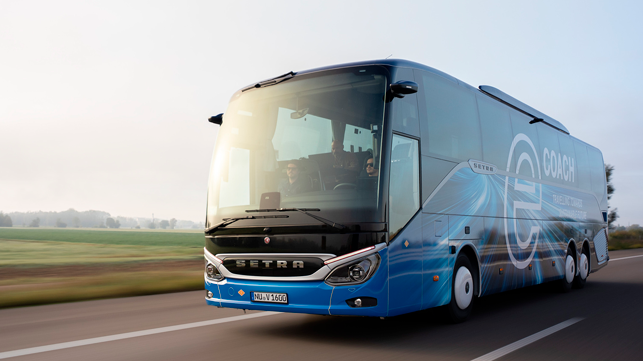
A range of more than 500 kilometers for a battery-electric tour bus: That is the target of the ELCH research project. A joint test drive by the project partners now marks an important milestone. ITIV is contributing to the development of the electric tour bus of the future through data-driven analysis and AI-supported optimization.

The new Energy Materials Acceleration Platform (E-MAP) at the Karlsruhe Institute of Technology (KIT) enables a systematic examination, evaluation, and targeted refining of thousands of material variants. It links automated experiments with precise material characterization, thus creating the foundation for the accelerated development of energy materials.
“Robot systems perform tasks such as preparing materials, handling samples, thin-film deposition and sample characterization,” said Dr. Holger Röhm from KIT’s Light Technology Institute (LTI), whose research team has set up the platform. “This allows us to conduct experiments with unprecedented precision and reproducibility. With the E-MAP, we can quickly identify which material compositions and production conditions are particularly promising for a specific application.” [...]